
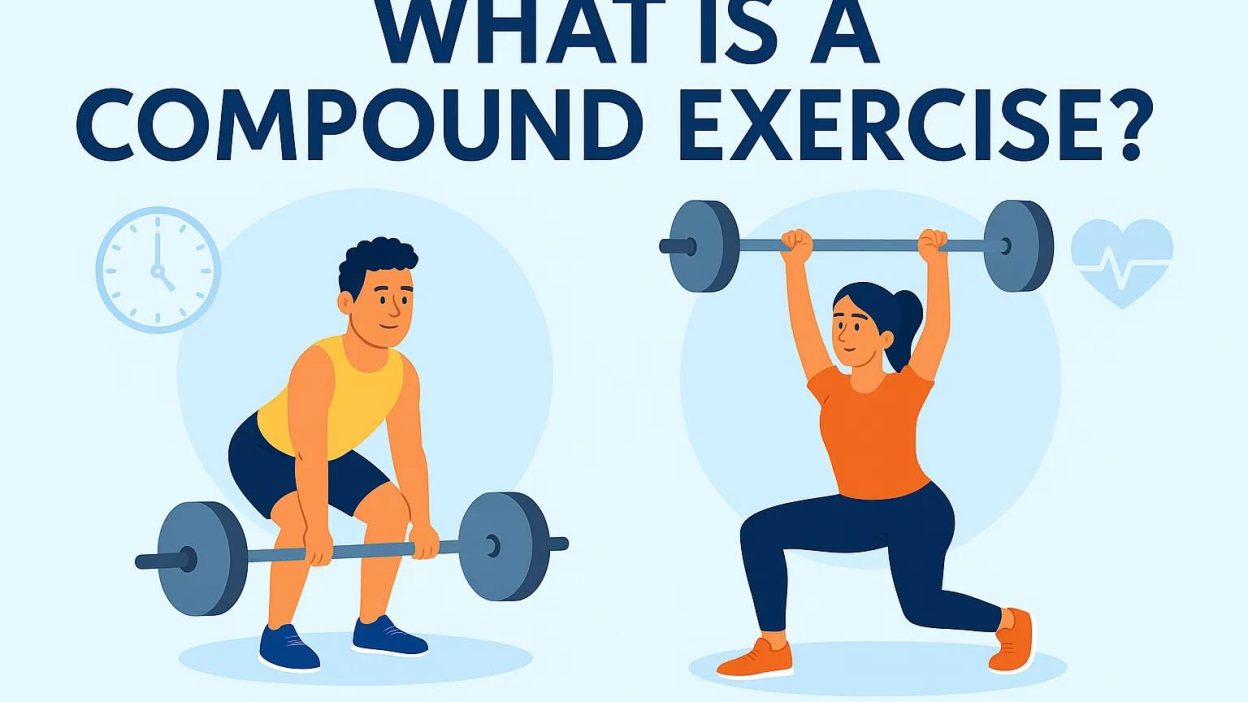
Compound exercises are powerful, efficient, and beginner-friendly. They work multiple muscles at once, helping you build strength, burn calories, and train smarter—not longer. In this guide, I’ll break down what they are, how they work, and why they should be the backbone of your fitness routine.
Definition of Compound Exercises
Compound exercises are movements that involve two or more joints and multiple muscle groups working together. Instead of isolating just one muscle, these exercises train your body as a unit—just like you move in everyday life.
Examples include:
- Squats – work your glutes, quads, hamstrings, and core
- Deadlifts – engage your entire posterior chain, including back, glutes, and legs
- Pull-ups – target back, biceps, and shoulders
- Push-ups – hit chest, triceps, shoulders, and core
- Rows – strengthen the upper back, biceps, and forearms
- Bench press – train chest, triceps, and front deltoids
Why do they matter? Because you get more done in less time. Compound movements burn more calories, build strength faster, and make your workouts more functional. They’re the foundation of any solid training plan.
How Compound Exercises Work

Compound exercises work by engaging multiple joints and muscle groups in a single movement. Take a squat, for example—you’re using your hips, knees, and ankles while firing up your quads, glutes, hamstrings, and core all at once.
Here’s what makes compound lifts so effective:
- Multiple joint action: Movements like deadlifts or push-ups use more than one joint, increasing range and complexity.
- Muscle group recruitment: You’re not just training one muscle—you’re training a system. This builds real-world, functional strength.
- Improved coordination and balance: With more moving parts, your body learns to stabilize, control, and move efficiently.
- Neuromuscular and hormonal response: These big lifts fire up your nervous system and release hormones like testosterone and growth hormone, accelerating strength and muscle growth.
In short, compound exercises train your body to move better, lift heavier, and work smarter. They’re as close to real-world movement as it gets.
Top Benefits of Compound Exercises
Compound exercises pack serious punch. They don’t just target one area—they give you more results with every rep. Here’s why I always include them in my workouts:
- Build total-body strength and muscle: By working multiple muscle groups at once, compound movements build balanced, functional strength from head to toe.
- Burn more calories: Because more muscles are working, your body uses more energy—making compound exercises ideal for fat loss and conditioning.
- Improve core stability and posture: Movements like deadlifts and rows engage your core naturally, helping you stay strong and upright during daily life.
- Save time: No need to isolate each muscle—compound exercises combine movements and deliver full-body benefits in fewer sets.
- Increase cardiovascular demand: Exercises like squats and push presses elevate your heart rate, boosting both strength and stamina in one go.
If you’re short on time but want maximum results, compound exercises are your best training tool. Efficient, effective, and endlessly scalable.
Compound vs Isolation: Key Differences
To build a balanced workout routine, it’s important to understand how compound exercises and isolation exercises differ. Both have value, but they serve distinct purposes in strength training and resistance training.
| Compound Exercises | Isolation Exercises |
|---|---|
| Multi-joint movements that engage many muscles and joints | Single-joint exercises targeting a specific muscle group |
| Train groups at the same time (e.g., hips, knees, shoulders) | Focus on one joint like the elbow or knee |
| Burn more calories and build overall strength more quickly | Ideal for strengthening a particular muscle or fixing imbalances |
| Example of a compound exercise: Deadlift (targets glutes, quadriceps, hamstrings, back, and core) | Example: Bicep curl (focuses on the elbow and biceps only) |
Compound exercises are a great way to maximize efficiency. They engage more muscle groups, require more coordination, and deliver better results in a short amount of time. For example, the compound exercise is the squat, which recruits the quadriceps, hamstrings, glutes, and even your lower back and core.
In contrast, isolation movements are exercises meant to strengthen a single muscle or a specific muscle. They come in handy when you need to focus on a particular muscle that may be lagging or recovering from injury. For instance, a leg extension targets only the quadriceps, and a tricep extension isolates the elbow joint and triceps.
While compound exercises help you build muscle, burn fat, and train smarter, isolation exercises have their place in fine-tuning strength, increasing muscle size, and improving symmetry. Most strength training programs benefit from a mix of both.
So when should you perform compound movements? Ideally, first in your session—when you’re fresh and able to lift heavier. Then use isolation work to polish off a specific muscle. This strategy will help you add compound exercises to your workout effectively, while giving each muscle or muscle group the attention it deserves.
If you’re unsure where to start, ask a fitness professional at your gym to demonstrate proper form. That way, you can safely perform a movement that works multiple muscles and joints, and get the most bang for your buck from every session.
Examples of Compound Exercises

Compound exercises are incredibly versatile. They can be done with barbells, dumbbells, kettlebells, or just your bodyweight—and they work multiple muscle groups and joints in every rep. Below are some of the most effective examples, organized by body region:
Upper Body
- Pull-ups: Train your back, biceps, and shoulders using your bodyweight.
- Push-ups: Work the chest, triceps, shoulders, and core—no equipment needed.
- Bench Press: Targets the chest, triceps, and front delts for upper-body strength.
- Barbell Rows: Engage your lats, traps, rhomboids, and biceps while stabilizing with your core.
- Overhead Press: Builds shoulders and triceps while demanding core stability and balance.
Lower Body
- Squats: One of the best compound exercises for building muscle strength in the quadriceps, glutes, hamstrings, and core.
- Deadlifts: A full posterior chain move that hits hamstrings, glutes, back, and grip strength.
- Lunges: Work each leg independently while challenging balance and coordination.
- Step-ups: Functional, beginner-friendly, and excellent for quads, glutes, and calves.
Full-Body
- Clean and Press: A dynamic movement combining a pull and push for total-body power.
- Kettlebell Swings: Explosive hip-driven motion that builds strength and boosts heart rate.
- Burpees: A full-body bodyweight exercise that combines a squat, push-up, and jump—ideal for conditioning and endurance.
If you want to perform compound exercises efficiently, start by adding 3–5 of these to your weekly resistance training plan. They’re functional, scalable, and deliver major results in a short amount of time.
How to Start with Compound Training
New to strength training? Compound exercises are a solid foundation for building total-body strength, stability, and coordination. Here’s how to ease into them without burning out or risking injury:
- Choose 3–5 big lifts: Start with classics like squats, deadlifts, push-ups, bench presses, and rows. These hit the most muscle groups efficiently.
- Master form first: Use light weight or bodyweight and focus on a full range of motion. Clean form helps prevent injury and ensures proper muscle engagement.
- Start with bodyweight or machines: Can’t perform a barbell squat yet? Use machines or dumbbells to build the necessary strength and confidence.
- Add weight progressively: Once you’ve nailed the form, slowly increase the weight every week or two. This is key for growth and preventing plateaus.
- Prioritize compound movements early: Always place them at the start of your workout when you’re fresh and focused. That’s when you can lift best and safest.
Whether you’re training for strength, aesthetics, or athletic performance, compound lifts are the engine of your workout routine. Lay the groundwork now, and your future self will lift heavier, move better, and feel stronger.
How to Program Compound Exercises

Compound movements are powerhouse performers—but only if you program them right. Here’s how to fit them into your weekly strength training plan for the best results:
- Frequency: Aim to perform compound exercises 3–4 times per week. This keeps intensity high without overtraining any specific muscle group.
- Reps and sets: Do 3–5 sets of 5–10 reps. Stick to the lower end for building strength, and the higher end for hypertrophy and muscle size.
- Rest periods: Rest 60–120 seconds between sets, depending on your goal. Longer rest for strength; shorter for fat burn or endurance.
- Pair with isolation lifts: Use compound exercises and isolation exercises together for a balanced routine that hits both big movers and small stabilizers.
- Program style: Compound lifts work great in supersets, circuits, or classic splits. Just make sure they come early in the workout when you’re at peak energy.
Whether you’re chasing strength, size, or stamina, knowing how to perform compound lifts properly and program them smartly makes a massive difference in your training routine.
Common Mistakes to Avoid
Compound exercises can deliver major results—but only if you steer clear of these common slip-ups:
- Using poor form to lift heavier: Chasing numbers over technique can lead to injury. Master proper form before adding load.
- Neglecting warm-up and mobility: Cold joints and tight muscles make complex lifts riskier. Start with dynamic stretches and activation drills.
- Skipping rest days: More isn’t always better. Muscles grow and recover outside the gym—respect your rest.
- Training too many compound lifts in one session: Overloading your CNS and major muscle groups in a single workout can kill performance. Stick to 2–3 major lifts per day.
- Not progressively overloading: Without gradual increases in resistance or volume, your strength training will plateau. Track progress and challenge yourself weekly.
Avoiding these mistakes ensures your compound-focused workout routine delivers gains without setbacks.