


Thinking about your first ultra? A 50k race covers 31.07 miles—just far enough to feel epic without being overwhelming. In this guide, I’ll break down the distance, share beginner-friendly training tips, and walk you through what it really takes to conquer your first 50k with confidence and grit.
Understanding the Distance
A 50k race clocks in at exactly 31.07 miles. That’s just over 5 miles longer than a standard marathon (26.2 miles), but don’t be fooled—those extra miles hit differently, especially on rugged terrain.
Most 50k races aren’t run on paved roads. Instead, you’ll find yourself winding through forest trails, scaling rocky switchbacks, or trudging across rolling hills. This isn’t just a longer run—it’s a full-body, full-sensory adventure. The elevation, uneven footing, and mental fatigue make it far more than a “marathon plus five.”
| Distance | Kilometers | Miles |
|---|---|---|
| 5K | 5 | 3.11 |
| 10K | 10 | 6.21 |
| Half Marathon | 21.1 | 13.1 |
| Marathon | 42.2 | 26.2 |
| Ultra 50K | 50 | 31.07 |
So when someone says, “It’s just 5 miles more than a marathon,” smile politely—then lace up your trail shoes. Because a 50k isn’t just longer, it’s wilder.
Why Runners Choose the 50k Distance

The 50k is the gateway drug of the ultrarunning world—just long enough to push your limits, but approachable enough to feel doable. For many, it’s the first brave step beyond the marathon finish line and into the dirt-filled, sweat-streaked world of ultras.
Unlike road marathons where pace and split times reign supreme, 50k trail races offer something different: a slower pace, a softer surface, and a stronger connection to the experience. You’ll find yourself walking hills without shame, chatting with fellow runners mid-race, and stopping to refill your hydration pack at aid stations that feel like pop-up picnics.
So, why go 50k? Here’s why many runners do:
- Entry into Ultras: It’s the shortest official ultramarathon distance—perfect for testing your endurance.
- Less Pressure on Pace: You can walk, hike, and jog without obsessing over every mile marker.
- Mental Grit: It challenges your mind as much as your body—resilience matters more than speed.
- Scenic Routes: Trails beat traffic. The beauty of nature replaces the pounding of pavement.
- New Motivation: If marathons have lost their magic, a 50k rekindles the thrill.
In short, it’s not just about going farther—it’s about running differently. And once you taste the trail, there’s no turning back.
Is a 50k Ultra Marathon Really That Different?
Absolutely. A 50k ultra marathon doesn’t just stretch your mileage—it reshapes your mindset, training strategy, and race day approach. It’s not a “longer marathon,” it’s a different discipline altogether. Let’s break down what makes it unique.
Mindset Shifts
- “Time on feet” vs. pace per mile: Ultras aren’t about speed—they’re about staying strong and steady for hours. You’ll learn to measure success in stamina, not splits.
- Fueling strategies matter more: Nutrition and hydration aren’t optional. Eating early and often is what keeps you upright and moving.
- Trail awareness is key: Unlike road races, trails demand your attention. Roots, rocks, and route-finding make every step a decision.
Physical Challenges
- Longer time under stress: Your body is active far longer than during a marathon—fatigue builds differently and deeper.
- More muscle breakdown: Technical terrain and slower paces mean more wear on stabilizers, especially your quads, glutes, and ankles.
- Elevation gain and loss: Hills become their own obstacle course, draining energy and demanding recovery on the fly.
Race Day Realities
- Less frequent aid stations: You might go 5–8 miles without support. Self-reliance is part of the game.
- Different gear requirements: You’ll likely need a hydration vest, trail shoes, and possibly trekking poles or a headlamp.
- Trail etiquette and awareness: Stay on the path, leave no trace, yield to faster runners or hikers—respect the land and your fellow racers.
Running a 50k is a whole new sport compared to a road marathon. And once you embrace its rhythm, it can be one of the most rewarding experiences you’ll ever have on two feet.
How to Train for a 50k: The Basics

Training for a 50k isn’t just about running more—it’s about running smarter. You’ll need a well-structured plan that builds your endurance, tests your mental grit, and prepares you for the specific challenges of ultra-distance trail racing. Here’s what to expect when laying the groundwork for your first (or next) 50k.
How Long Should You Train?
Your training timeline depends on your experience and current fitness. If you’ve run marathons before, you can get race-ready in as little as 12 to 16 weeks. But if this is your first ultra or you’re coming off a low-mileage base, plan on 20 to 24 weeks to give your body time to adapt gradually and avoid injury.
The key here? Patience. Ultramarathon success isn’t built overnight—it’s earned mile by mile.
Weekly Mileage Recommendations
You don’t need to run 100-mile weeks to train for a 50k. What matters more is consistent mileage, strategic progression, and smart recovery. Here’s a general guide:
- Starting mileage: 25–30 miles per week
- Peak mileage: 45–60 miles per week
- Key workouts: Back-to-back long runs on weekends and midweek volume
- Recovery: Drop mileage every 3–4 weeks to allow adaptation
Training on similar terrain to your race (i.e., trails, hills, technical paths) will make a huge difference come race day.
Training Phases
A structured 50k training plan should follow four progressive phases. Each one builds on the last, guiding your body from base fitness to race-day readiness:
- Base Building (Weeks 1–6): Focus on aerobic endurance with easy miles and some strides. Build consistency, not speed.
- Endurance & Volume (Weeks 7–12): Add long runs, elevation gain, and introduce back-to-back run days.
- Peak & Specificity (Weeks 13–16): Mimic race conditions. Include gear tests, fueling practice, and tough trail runs.
- Tapering (Final 2–3 weeks): Reduce mileage to allow recovery and peak performance. Keep intensity moderate, and resist the urge to cram.
Stick with this timeline, listen to your body, and you’ll toe the start line feeling strong, steady, and ultra-ready.
Sample 16-Week 50k Training Plan (Beginner)

New to the ultra scene? This 16-week beginner-friendly training plan gives you a clear roadmap to go from casual runner to confident 50k finisher. It balances volume, recovery, and real-world trail prep—without burning you out.
Weekly Structure Example
Each week follows a rhythm that builds endurance, strength, and trail-specific skills while allowing for recovery. Here’s a basic weekly layout:
- Monday: Rest day or easy 3–4 mile recovery run
- Tuesday: Intervals or hill repeats (3–6 miles total)
- Wednesday: Medium-long run or cross-training (cycling, hiking, swimming)
- Thursday: Easy run or moderate-effort tempo run (4–7 miles)
- Friday: Rest day—no guilt, full recovery
- Saturday: Long run, gradually increasing distance (start at 8 miles and build to 22+)
- Sunday: Recovery jog or second long-ish effort (6–10 miles) to simulate running on tired legs
Key Sessions
Not all miles are created equal. These sessions are non-negotiable if you want to toe the line with confidence:
- Long trail runs: Slowly increase the distance and time on feet—this is your dress rehearsal for race day.
- Back-to-back long runs: These train your body (and brain) to move through fatigue and recover quickly.
- Nutrition runs: Practice eating and hydrating like you will during the race—every long run is a test run for your stomach.
- Gear checks: Wear your race-day shoes, hydration vest, and clothing during key runs to avoid surprises.
- Taper weeks: The final 2–3 weeks are about reducing volume while maintaining intensity—trust the process.
Downloadable PDF 16-Week 50k Training Plan for Beginners
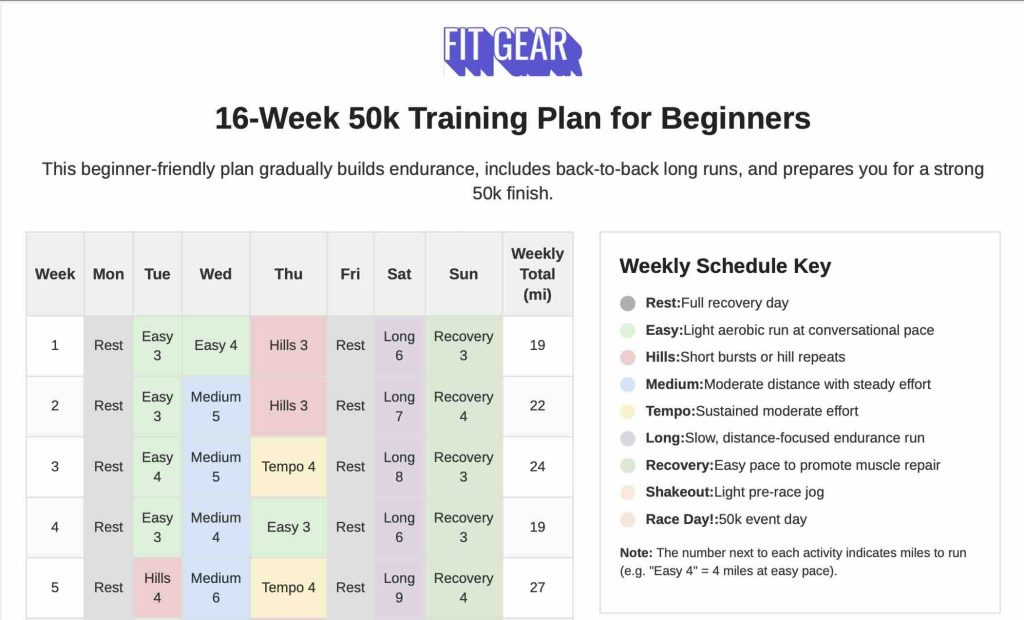
Want to keep this plan handy on your phone or print it out? Download Your Free 50k Training Plan for Beginers Here and take the guesswork out of ultra prep. Stick to the schedule, and you’ll be trail-ready in 16 weeks flat.
Must-Have Gear for 50k Training

Training for a 50k is more than just logging miles—it’s also about having the right gear to stay safe, fueled, and comfortable. Whether you’re hitting dusty desert trails or soggy forest paths, the right setup makes all the difference. Here’s what you need in your kit.
Essentials
- Trail running shoes: Look for shoes with solid grip, rock plates, and durability to handle uneven terrain. Comfort over speed.
- Hydration vest or handheld bottles: Aid stations are sparse during ultras. Carry fluids and fuel with you every run—train how you’ll race.
- Technical socks: Ditch cotton. Choose moisture-wicking, padded socks designed to reduce friction and prevent blisters.
- Headlamp or running belt light: If you run early mornings, late evenings, or pre-dawn long runs, visibility is non-negotiable.
- Energy gels or trail snacks: Practice with whatever you’ll use on race day—gels, chews, dried fruit, or nut butter packets. Know what your gut likes.
Optional But Useful
- Trekking poles: If your race has significant elevation, poles can reduce fatigue and boost efficiency on climbs.
- GPS running watch: Track mileage, elevation, and pace to monitor your training and avoid getting lost on new trails.
- Chafing balm: Apply to hotspots before long runs. No one enjoys surprise chafing at mile 20.
- Electrolyte tablets or drink mixes: Replacing salt is crucial on hot or long runs—water alone won’t cut it.
- Weather-ready gear: A light hat, gloves, or windbreaker can turn a miserable training day into a manageable one when conditions shift.
Test everything during your training runs. Nothing new on race day, not even socks. Comfort, reliability, and preparation win ultras—not the flashiest gear on the rack.
Fueling & Nutrition Strategies
In a 50k, your success hinges as much on what you eat as how you run. Nutrition isn’t an afterthought—it’s a core part of ultra training. Get it wrong, and even the strongest legs can’t save you. Here’s how to fuel right, both in training and on race day.
During Training
Training is the time to test everything—your pacing, your gear, and especially your nutrition. You’re not just building endurance; you’re training your gut.
- Practice fueling on long runs: Start eating early (around 30 minutes in) and continue every 30–45 minutes.
- Target 30–60g of carbohydrates per hour: That’s about 1–2 gels or equivalent in chews, waffles, or trail snacks.
- Balance fluids and electrolytes: Don’t just chug water—include salt tabs, electrolyte drink mixes, or foods with sodium to prevent cramps and fatigue.
Pro tip: Try fueling during back-to-back long runs. This helps simulate race day fatigue and gives you real-time feedback on what your body can handle.
Race Day Nutrition
When race day comes, stick to what your body knows. This is not the time to experiment with new snacks or drinks.
- Don’t try anything new: Race morning is not the moment to test a new bar or sports drink. Stick to what worked in training.
- Use aid stations wisely: Know where they are and what they offer. Plan to supplement—not rely entirely on them.
- Mix your options: Gels, energy chews, PB&J sandwiches, bananas, dried fruit—variety helps prevent taste fatigue and GI distress.
The golden rule: eat before you’re hungry, drink before you’re thirsty. A steady stream of calories and hydration keeps your energy high and your finish line in reach.
Tips for Success on Race Day

After weeks of training, race day is your time to shine—but preparation doesn’t stop at the start line. What you do during the final week and on the course can make or break your 50k experience. Here’s how to set yourself up for success, from taper to finish line.
Race Week Checklist
- Taper right—don’t cram: Trust your training. The last 7–10 days are for rest and recovery, not for squeezing in extra miles. Let your body absorb the work.
- Check gear and nutrition: Test every item you plan to race with—shoes, socks, vest, fuel. No surprises allowed.
- Hydrate and sleep: Start drinking water and electrolytes several days before. Aim for consistent, quality sleep the week of the race—even if nerves hit the night before.
During the Race
- Start slow and stay steady: Adrenaline is high at the start, but going out too fast will catch up with you. Let others fly past—you’ll see them again.
- Walk the hills: Power hiking conserves energy and is a smart move on steep or technical climbs. Efficiency matters more than ego.
- Fuel early and often: Don’t wait for hunger. Stick to your fueling schedule and sip fluids regularly, even if you don’t feel thirsty.
- Listen to your body: Adjust pace, take breaks, and troubleshoot any discomfort before it becomes a problem.
- Smile: You’re running an ultra—through nature, with your own two feet, doing something most people never attempt. That alone is worth celebrating.
Every step, from the nervous start to the final mile, is part of the journey. Embrace the ups, power through the downs, and finish strong—you’ve earned it.
Common Mistakes First-Time 50k Runners Make

Training for and running your first 50k is a major milestone—but even well-prepared runners can stumble if they fall into common traps. Knowing what to avoid is just as important as knowing what to do. Here are the top mistakes I see beginners make—and how you can sidestep them.
Top 5 to Avoid
- Not fueling early or consistently: Waiting until you’re hungry or tired to eat is too late. Start fueling within the first 30–45 minutes and keep it steady throughout the race.
- Skipping rest days or underestimating recovery: More miles don’t always mean better fitness. Your body needs downtime to rebuild stronger. Don’t treat rest as optional—it’s essential.
- Wearing new gear on race day: Race day is not the time for debuting new shoes, socks, or packs. Even a small change can cause chafing, blisters, or unexpected discomfort.
- Over-pacing the first 10 miles: Adrenaline will tempt you to go fast early. Resist it. A steady start helps you stay strong through the final miles, where it really counts.
- Neglecting strength and mobility work: Trail ultras test your stabilizers, hips, and core. Skipping strength training or stretching can lead to injuries and burnout when mileage climbs.
Recognize these pitfalls early, and you’ll be miles ahead—literally and mentally—by the time race day arrives.
50k Ultra Marathon FAQs
Is a 50k harder than a marathon?
It can be, depending on the terrain and pacing. While the distance is only about 5 miles longer, most 50k races are on trails with elevation changes, technical sections, and longer time on your feet. Nutrition and mental endurance matter more than raw speed.
Can I walk during a 50k?
Yes! Walking is not only allowed—it’s expected. Most runners walk steep uphills, take short breaks at aid stations, or hike technical sections. In ultras, efficiency is the name of the game, and walking smartly can save energy and prevent burnout.
How much should I eat during a 50k?
Aim for 200–300 calories per hour. That might include energy gels, chews, sandwiches, fruit, or even real food like boiled potatoes or PB&J. Every runner is different, so practice your nutrition strategy during long runs to see what your stomach can handle.
Can I run a 50k without running a marathon first?
Yes, you can! While having marathon experience helps, it’s not a requirement. Many runners train specifically for a 50k as their first endurance event. Focus on building a strong aerobic base, gradually increasing long run distance, and getting comfortable on trails.
Final Thoughts
Running a 50k isn’t just about mileage—it’s about mindset. These races stretch your limits, both physically and mentally, and reward you with something no ordinary finish line can offer: real grit, raw joy, and a deeper connection to your own strength.
A 50k ultra is more than “just a little farther” than a marathon. It’s an adventure—on dirt paths, over hills, through doubt, and into something unforgettable. It teaches patience, fuels resilience, and demands respect.
So train smart. Fuel like it matters—because it does. Gear up with intention. And most of all, show up ready to embrace every step, whether it’s fast or slow, muddy or magical.
Whether you cross that finish line with a sprint, a shuffle, or a tear-streaked grin, one thing is certain: you won’t be the same person who started. And that’s the real win.